Sunday, 29 March 2015

An Interesting Character


Nervous, nervous, nervous! I sit in the reception of the office of a high-class entertainment magazine—I’m here for a job interview. I observe some chic girls/employees strutting around the office, and I instantly know that I’m a misfit here. Soon, I’m called in to meet the Editor. More nervous, nervous, nervous!

Having battled the scorching heat outside, I am and look a complete mess when I enter the Editor’s cabin. My handbag slips down my arm shabbily; a plastic cover looking more crumpled than folded is in my left hand; and I’m holding a folder with the right.

I see the Editor slowly scan me up and down. Surprisingly, at this point, my nervousness vanishes. Just like she’s amused by the picture I cut in front of her, so am I by her form and manner. Here was hoity-toity sitting on a tall chair with a tiny pillow squeezed behind her neck—perfect for the role of the Victorian drama queen, who’d swoon at the drop of a hat!

“Sit down,” she says in her high-pitched, nasal voice—the kind of voice that one would associate with a witch from a fairytale. (Hey, don’t call me mean; blame it on storytelling stereotypes!) Looking at her, I think: Now is my chance to prove that I am no less refined and sophisticated than her. So, I ‘gently’ pull the chair closest to me a little behind, but it goes… Screeeeeech! Excellent. The chair, which was behaving like her ‘pet’, must have read my thoughts. Why else would a chair screech? No more chair-moving, I resolve, and ‘gently’ try and squeeze myself through the gap between the chair and her desk, so that I can sit down… But I half fall on the desk… She gives me a piercing look… Mumbling a sorry, I collect myself and flop onto the chair somehow.

The silly pet chair still has its way: it is too low for me to even see the Editor’s face. In between her face and mine, now stands her pet PC monitor. Praying, I ‘gently’ shift the chair a little again, so that I can see half her face and she half of mine. Then begins the questioning: two questions down, I already know that she has already made up her mind about me and that she is not interested in my answers. So, I relax and begin giving unrelated, random answers, which she (strangely) graciously accepts without a second thought. Good for me!

She tells me that I have a mountain of a task to deal with if I am hired, adding that she is not very sure I can handle it all. I smile. “I cannot afford a single spelling error in my magazine!” she heaves. Errr…Should I tell her about the three glaring mistakes I spotted while glancing through the glossy mag? Nah! What if she faints or gets a heart attack? And who wants homicide charges! I continue listening to her… “Around 10,000 people read my magazine every day… And I get at least 500 letters in a day, if there is an error, saying they saw one spelling mistake…” My brain explodes with silent laughter: Hahahaha… Who are these 500 readers who have no work but to write to the Editor of a magazine about one spelling mistake?

She looks down at my CV. Suddenly, she crinkles up her nose like she could smell a gutter… Is she going to sneeze? Nope. There’s chaos and disgust in her eyes. She looks at me horrified and asks me in high-pitched shock as to where my place of residence exists. She has never heard of that place. Well, names of places don’t always have an uppity ring to them—mine was one of those unfortunate areas. I try telling her where it is located, but in vain. She gives me the ‘How can such LS beings even dream of working here in my team?’ look. I give her a fake, understanding smile.

However, she generously allows me to go to Level 2 of the interview; she leads me into the edit room for a copy test. That’s when she turns abruptly and asks me the question of the century: “What’s your name?” And to think that she had stared at my CV and interviewed me all this while. Clean bowled! I tell her my name, and proceed towards my test.

Midway through my copy test, I notice that the team members speak to each other only in whispers. A pre-requisite to pass off as svelte, perhaps. Just then, I hear the Editor’s high-frequency sneeze reverberate through the otherwise silent office. Then she lets out a groan… Is she dead? Another sharp sneeze and another painful groan... This time, I’m sure her brains spilled out. I expect her high-pitched alarm to go off. She doesn’t disappoint. The poor snoot calls out like it’s an emergency, “Can someone please come here?” And someone goes running to her cabin.

Soon enough, she comes into the edit room and says, “Nandini!” Yes, she was addressing me so. And to think I had just told her my name fifteen minutes ago. I correct her. A fake apology later, she tells me she’s off for the day and leaves.

As I walk out of the office a little later, after completing my test, I know for sure that the Editor won’t hire me, irrespective of how I’d done the test. But what I learnt more importantly from this interview is that snobbish characters such as this Editor don’t just exist in storybooks and movies. Beware, they’re out there!

Saturday, 21 March 2015

Meeting the Lion


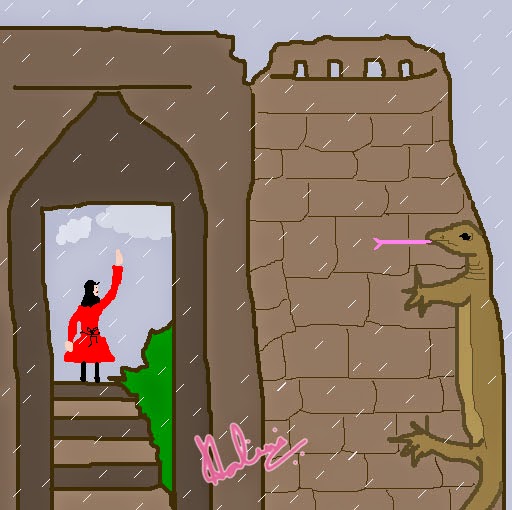
It was never part of our Pune trip’s itinerary, but one fine rainy morning, we were off to one of the most famous forts of Maharashtra. I was too young then. But I remember every little thing that I liked about that journey. The curving roads; the pleasant weather; the cool breeze hitting my face; the green hills and the greener valleys; the chatter of my family, relatives, and cousins; and the beautiful, divine drizzle. I was transported into ‘Anotherland’!

It was so foggy that I could hardly see the humungous walls of the fort that were just three feet away from me. You see it now and now you don’t. Thrilling, for a kid of my age. Steep steps, sturdy walls, mysterious hideaways, secret paths, randomly wriggling snakes—it was unreal, and yet, it was all there.

Reaching the topmost point of the fort, I realised that nature is such a soothing element. For the first time in my life, drops of rain fell on me while I saw the clouds above, and the clouds below—and then, I touched a passing cloud. Unforgettable!

Standing there, the history of the fort unfolded in my mind. Shivaji. Tanaji Malusare. The famous ghorpad or monitor lizard, Yeshwant. The difficult climb, the great battle, the historic sacrifice. Stories have immense power, and as I soaked in that moment, I felt it all—the power of history, the power of heritage and legacy, the power of nature. The power of a fort called Sinhagad*!

*The fort, named Kondana earlier, was recaptured by Shivajis forces under the leadership of Tanaji Malusare. On hearing that the battle had claimed Malusares life, Shivaji had said, The fort is won, but the lion is gone. In the honour of the brave warrior, Shivaji then renamed the fort as Sinhagad—when translated from Marathi to English, Sinhagad means Lion's Fort’.

Thursday, 24 July 2014

Crowning Glory


She was just back from the parlour and she couldn’t stop admiring her new look in the mirror. She noticed the reflection of her dad, who had just entered her room. He looked unhappy. “I don’t like it. You had such enviable long hair. Why did you get it cut? This doesn’t look good at all,” he mumbled and walked off. Stunned and equally irritated, she looked at her new haircut again. And once again, she liked what she saw. But what is the whole fuss about long hair? That’s a question familiar to many women. A dismissive response would point to a single word, ‘tradition’. But this prejudice may require further exploration, deep into its roots.

Speaking specifically of India, one must begin from the top—the Goddesses. Be it Raja Ravi Varma’s paintings, live action mythological series on television, films based on our epics, or idols in places of worship, any and every depiction of these celestial beauties has always been of one with long, flowing hair. It is a given that portrayal of these supernatural women sporting short hair will be considered inappropriate and blasphemous. Since people tend to see deities as mirror images of their own being and vice-versa, this fixation for long hair becomes obvious. So there is no choice, but to take the Hindi saying literally: Beti toh Lakshmi ka roop hoti hai.

Adding to the convenience of this belief system are legendary folklore and mythical fairytales from other countries. Greek Goddesses, pretty nymphs, and who can forget Rapunzel! Come on, it wasn’t her fault—the nasty witch chopped off her thick, long tresses. And if the Prince could magically get his eyesight back, Rapunzel too would have definitely got all that hair back. For time immemorial, the length of a woman’s hair (they are second to nothing but her looks) has been an important factor for men to find her attractive and beautiful. Why?

Thick and long tresses are a sign of youth and good health. Quite a few men feel that long hair gives to women that one most desired quality they expect to see in women—grace! Swaying long hair seems to be weakening many hearts. Moreover, long hair allows greater scope for styling and beautification. Where else would adornments such as flowers and butterfly clips have found a place? A woman who styles her long hair skilfully is seen as an aesthete. In ancient times, queens and princesses had maids to wash, dry, comb, manage, braid, and decorate their long hair. That is how it became an indication of wealth and prosperity. Also, for centuries, various cultures have proclaimed flowing, gorgeous hair to be symbolic of a woman’s individual sexuality and virginity.

Little wonder then that young men cite long hair as one of the pre-requisites when conjuring up an image of their dream girl. At a sub-conscious level, they may find it easier to mention such requirements as opposed to actually listing out what they are looking for in a woman/partner. The family of such a young man chooses to interpret this feature in a woman as per their own age-old wisdom. A girl who can manage and maintain her long hair well (which is a task) will be adept at managing the family. She is seen as ‘homely’ and she will showcase essential ‘good behaviour’. In contrast is a young girl who has chopped off her long hair—the reason for this is usually presumed to be lack of patience or time to maintain them. So, if she does not have time to look after her own hair, how will she even think of household affairs!

Sociologically, long hair has been/become one of the distinguishing traits for gender identification and discrimination, making it a marker of femininity. Accordingly, women with short hair are assumed to be unfeminine, ‘modern’, and thereby, rebellious. Feminists from differing schools of thought will be most proficient in an unending debate over this. Science tells us that healthy, long hair means a good protein intake. This further means more energy and more brainpower. Could that be why it is deduced that women with long hair will have the ability to handle circumstances coolly and with enough mental strength?

This representation of strength is what advertisers cash in on. A perfect example is the shampoo ad that shows a woman tying her hair to a truck stuck in muck, and then pulling it out. She single-headedly does what a group of men failed to do. The awe and triumph of the female gender is evident on the faces of other women onlookers—both young and old. The only weapon the woman protagonist required to conquer the impossible was her own thick, strong, long hair. Advertising efficiently uses ancient or traditional beliefs to play upon sentiments and continue this cycle of opinions.

Fiction too does not lag behind in reinforcing the partiality for long hair. Television soaps generously and glaringly use wigs and hair extensions for all women characters. ‘Shoulder-length hair is too short and waist-length hair is not long enough’ seems to be their mantra. Women characters with short hair are almost non-existent or, if shown, are depicted to be tomboys.

Princess Diana was an obvious exception to this rule. One can easily call her the epitome of womanly grace. But will she have looked more beautiful and elegant if she had lustrous waist-length hair is a question that will remain unanswered. And till then, short-haired women can only hope that traditionalists keep out of their hair, while their adversaries let their hair down, uninhibited.